
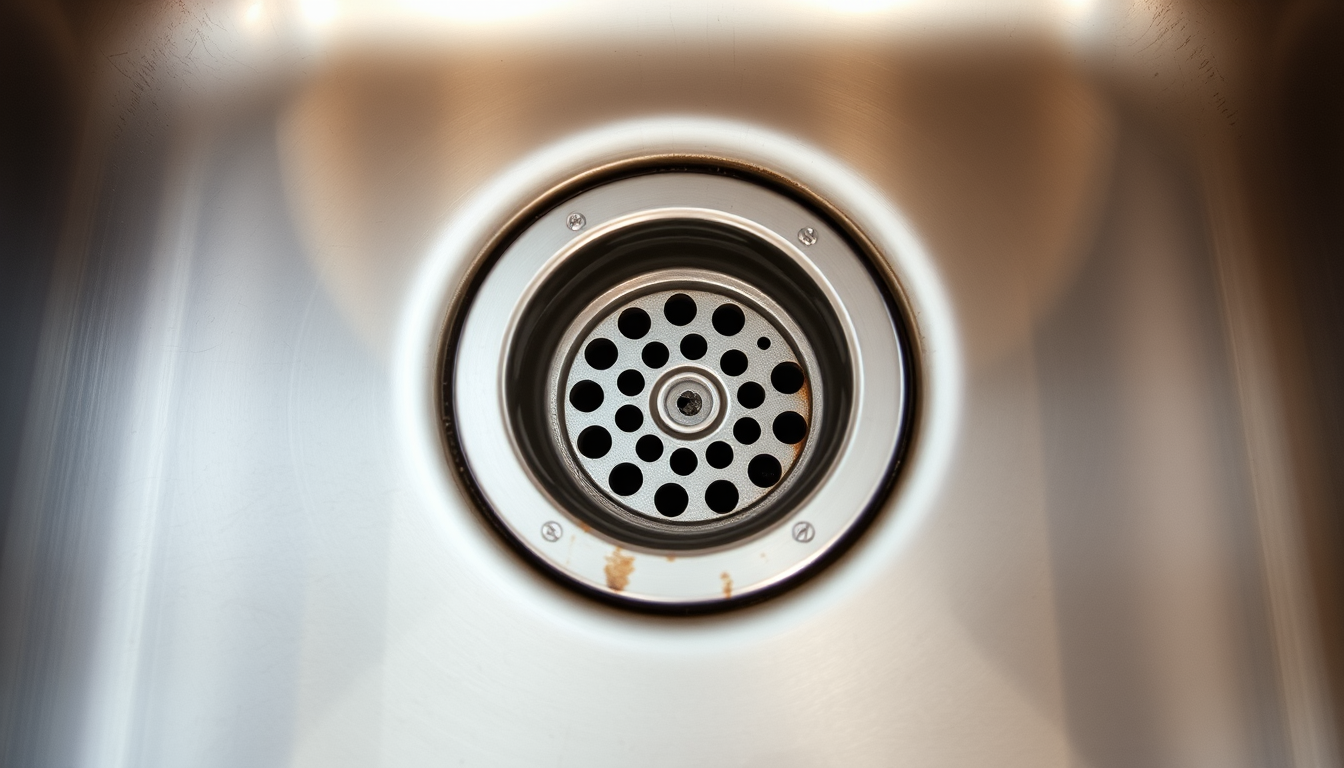
When your kitchen sink smells and the basin is spotless, the odor isn’t coming from the sink. It’s coming from the drain. Almost always it’s one of five things: a grease film coating the pipe wall, food sludge and biofilm in the strainer or disposal, a P-trap that has lost its water seal, a blocked vent, or a restriction farther down the branch line or sewer lateral.
Which one you have isn’t a guess. The type of smell and the timing of the smell narrow it down in about five minutes. Do that before you pour anything down there, because the five causes have five different fixes and three of them can’t be solved with a bottle.
Key takeaways:
- Sour, rotting-food smell means debris upstream. Rotten-egg smell means sewer gas is getting past a barrier that should be stopping it.
- The P-trap holds standing water on purpose. Code requires a liquid seal of 2 to 4 inches, and that water is the only thing between your kitchen and the sewer.
- Grease is the number one cause of sewer blockages nationally. It doesn’t wash away with hot water. It cools and sticks a few feet down.
- A smell that returns within days of a good cleaning isn’t a cleaning problem. Something in the line is holding material.
What Is the Smell Actually Telling You?
Different odors come from different chemistry, so the smell is a real diagnostic clue. Sour, rotten, garbage-like odors come from food decomposing near the drain opening. Rotten-egg and sulfur odors come from hydrogen sulfide, which the Illinois Department of Public Health describes as a gas that can result from bacterial breakdown of organic matter and be produced by human and animal wastes, with a strong odor similar to rotten eggs. That gas lives on the sewer side of your plumbing. If you can smell it, something that’s supposed to seal it out isn’t sealing.
Timing matters as much as the smell itself. Match your situation to one of these:
- Sour or garbage smell, strongest when water runs: debris and biofilm in the strainer basket, the disposal, or the first stretch of pipe.
- Rotten-egg smell, constant, no water needed: sewer gas. Suspect a dry or damaged trap, or a vent problem.
- Rotten-egg smell only after a big water event, like a dishwasher cycle or a full sink draining: pressure is pushing gas past a seal. That points to venting or a downstream restriction.
- Musty or mildew smell, worst when you open the cabinet: usually a slow leak wetting the cabinet floor, not the drain interior. Check the base of the P-trap and the shutoff valves with a dry paper towel.
One caution on the rotten-egg case. OSHA notes that hydrogen sulfide causes loss of smell after 2 to 15 minutes (olfactory fatigue) at higher concentrations. So “it stopped smelling” is not proof the problem went away. Household sewer gas is usually a nuisance rather than an emergency, but a persistent sewer odor in a living space deserves a real diagnosis, not an air freshener.
What Causes Kitchen Sink Smells?
Five causes account for nearly every case of kitchen sink smells. Here they are in the order we find them on service calls.
1. Grease Coating the Pipe Wall
Grease is the single most common cause of drain blockages, and the kitchen sink is where it enters the system. Clemson Cooperative Extension, citing EPA figures, reports that grease from restaurants, homes, and industrial sources are the most common cause (47%) of reported blockages. It goes down warm and liquid, cools within a few feet of pipe, and sticks to the wall. That layer then catches coffee grounds, rice, and eggshell fragments, and the whole mass sits there fermenting between uses.
So the smell often has nothing to do with how clean the basin is. The source can be six feet away, inside a horizontal run you’ll never see without a camera.
2. Food Sludge and Biofilm in the Strainer and Disposal
This is the easiest cause to confirm and the easiest to fix. Pull the strainer basket and look at the underside of the rubber splash guard in the disposal. That’s a favorite spot for a black film of decomposing food, a slime layer called biofilm that bacteria build on any wet surface with a food supply. Wipe it with a paper towel. If the towel comes back black and smells like the sink, you found at least part of your answer.
3. A Dry or Damaged P-Trap
The U-shaped pipe under your sink isn’t there to catch rings. It holds a plug of standing water that physically blocks sewer gas from entering the room. Plumbing code sets that seal at not less than 2 inches and not more than 4 inches of liquid. Lose it and the sewer is open to your kitchen.
Traps go dry from disuse. That’s why a bar sink, a guest kitchenette, or a vacation rental in Guerneville or Bodega Bay smells the moment you walk in, then improves after you run water. Traps also get siphoned dry by pressure swings when venting is inadequate, and an old corroded trap sometimes never holds a full seal at all.
4. A Blocked or Damaged Vent
Your drain system needs air. Vent piping runs up through the roof so air can enter behind draining water. When it’s blocked by debris or a nest, water in the stack pulls a vacuum instead, and that vacuum siphons trap seals out. The tell is gurgling. If the sink burps or the water level visibly drops when the dishwasher discharges, you’re looking at an airflow problem, not a dirty drain.
5. A Restriction Downstream, in the Branch or the Sewer Lateral
This is the expensive one, and the kitchen often announces it first because the kitchen sends the greasiest, warmest water into the line. If the sink smells and drains slowly, or other fixtures gurgle when the kitchen drains, the problem has moved past the trap. Sonoma Water states that private building laterals can be compromised by tree root intrusions, grease buildup, pipe cracks, and pipe sags, and that the property owner is responsible for that pipe from the building to the point of connection with the sewer main.
Age is a real factor around here. Sonoma County’s median year of construction for housing units is 1980 per Census Reporter’s American Community Survey profile, and plenty of the stock in Santa Rosa, Petaluma, and Sebastopol predates that. InterNACHI puts the life expectancy of below-ground cast-iron waste pipe at 50 to 60 years. Cast iron that old has a rough, rust-pitted interior that grabs grease the way smooth ABS never would, and clay laterals of the same vintage have joints that roots find.
How Do You Tell Which Cause You Have?
Run these five checks in order and write down what happens, because the pattern is the diagnosis.
- Smell the drain opening, then smell inside the cabinet. If the cabinet is worse, you have a leak and a wet cabinet floor, not a drain odor. Stop here and find the leak.
- Run cold water for thirty seconds, then stop and smell again. If the odor disappears and stays gone, you had a dry trap. Refilling it fixed it.
- Pull the strainer basket and wipe under the disposal splash guard. Black film means upstream debris. That’s your cheapest cause.
- Fill the basin completely, then pull the plug and listen. Gurgling at this sink or any other fixture means air is moving where it shouldn’t. Vent or downstream problem.
- Run the dishwasher and watch the sink. If water rises in the basin, or the smell spikes during discharge, the line is restricted below the trap.
Which fixtures reacted? That’s the whole test. Here’s the rule a drain tech works from: kitchen sink smells with no other symptoms sit upstream of the trap, where you can reach them. Kitchen sink smells plus gurgling at a second fixture sit downstream of where those two pipes meet. That one distinction decides whether this is a scrub-brush job or a camera job, and it costs you nothing to run.
What’s the Smelly Drain Fix You Can Do Yourself?
The smelly drain fix you can do at home has exactly three steps, and it takes about half an hour. Refill the trap seals, scrub what you can physically reach, then flush the loosened film out. Anything past that is inside pipe you can’t get to.
Start by pouring a couple of quarts of water down every rarely used drain in the house. That restores trap seals. Then pull the strainer basket and lift out the disposal splash guard if it comes free, and scrub both sides with dish soap and a stiff brush. With the power off at the breaker, scrub the grinding chamber walls you can reach. Finish with several minutes of hot tap water and dish soap running while the disposal turns, which emulsifies the loose film and carries it out.
Prevention is the part that sticks. Wipe greasy pans with a paper towel before they hit the sink. Scrape plates into the compost bin instead of the disposal. Keep coffee grounds, rice, pasta, and fibrous vegetable trimmings out of the drain entirely, because they either swell or bind with grease.
What to Skip
Baking soda and vinegar fizzes because an acid and a base neutralize each other, and that reaction is finished in seconds. Harmless, mildly deodorizing, and useless against hardened grease, a sagging pipe, or a root mass.
Boiling water is riskier than people think. ABS and PVC drain piping have real temperature limits, and repeatedly dumping boiling water into a plastic trap or a glued joint trades a smell for a leak inside a cabinet or a wall. Hot tap water with dish soap does the same emulsifying work without the risk.
Chemical drain cleaner is the one we’d argue hardest against in a kitchen line. It won’t touch a hardened grease deposit six feet downstream, and it leaves caustic liquid standing in the trap for whoever opens that joint next. That may well be you.
How Do Pros Clear a Kitchen Line for Good?
By finding out what’s in the pipe before choosing a tool. Kitchen sink smells that survive a real cleaning are a grease and buildup problem, and grease responds to only one thing well. Here’s how the common methods compare.
| Method | What it actually does | Right for | What it won’t fix |
|---|---|---|---|
| Cabling (snaking) | Spins a steel cable to cut a passage through a soft blockage | A one-off clog you need cleared today | Leaves the grease layer on the pipe wall, so the odor returns |
| Hydro jetting | Scours the full circumference of the pipe with pressurized water, back toward bare pipe | Recurring odor and repeat grease clogs | Won’t repair a cracked, offset, or bellied pipe |
| Camera inspection | Runs a camera down the line to show the pipe wall and locate the defect | Working out why the smell keeps coming back | Diagnostic only, it clears nothing |
| Sewer repair or lining | Replaces or relines the failed section of lateral | Root intrusion, cracks, bellied sections | Overkill for a dirty strainer basket |
Grease and roots are different problems needing different tools, which is why the diagnosis comes before the truck gets unloaded. The EPA lists both among the causes of sanitary sewer overflows, naming fats, oils and grease (FOG) alongside tree roots entering through defects or openings in a sewer line. A camera inspection tells you which one you have. Hydro jetting ends a recurring grease odor because cabling bores a hole through grease rather than removing it. A root-invaded or cracked lateral is a sewer repair question rather than a drain cleaning one, and no amount of cleaning will hold.
When Should You Call a Drain Tech?
Call when your test points past the trap. Specifically, any one of these:
- The smell returns within days of a thorough cleaning.
- The sink drains slowly as well as smelling.
- Other fixtures gurgle when the kitchen drains.
- You have a persistent rotten-egg sewer smell with a wet, full trap.
- You’re in an older home and you’ve had repeat kitchen clogs.
Those all mean the material is in the pipe, not the basin, and you can’t reach it from above. Pipe age shifts the odds too. Sonoma Water reports that an estimated two-thirds of the sewer laterals in Sonoma Valley are at least 30 years old and likely in need of repair, and that lateral belongs to the property owner. In an older Santa Rosa or Sonoma home with repeat kitchen clogs, the smell is usually telling you something about the pipe, not the strainer.
If that sounds like your house, Rock Solid Drains works throughout Sonoma County and Marin. You can reach us at (707) 889-8191 or through our contact page, and we’re licensed in California, CSLB #1065909. If your test says dry trap or dirty strainer basket, though, save your money and do it yourself. That one’s genuinely a Saturday morning job.
Frequently Asked Questions
Why does my kitchen sink smell like rotten eggs?
A rotten-egg smell at a kitchen sink is hydrogen sulfide, meaning sewer gas is entering the room instead of staying in the drain system. The Illinois Department of Public Health describes hydrogen sulfide as a gas that can result from bacterial breakdown of organic matter and from human and animal wastes, with a strong odor similar to rotten eggs. The two usual paths are a P-trap that has lost its water seal and a vent problem siphoning that seal out. Run water for thirty seconds. If the smell clears, the trap was dry. If it persists with a full trap, something else is breaking the seal.
Does baking soda and vinegar actually fix a smelly kitchen sink drain?
No, not for a real drain odor. The fizzing is an acid and a base neutralizing each other, and it’s over within seconds. It’s harmless and can leave a drain smelling fresher for a day, but it has no effect on hardened grease coating a pipe wall, a dry trap, a blocked vent, or roots in a lateral. If baking soda fixes your smell for good, the cause was loose debris at the top of the drain, and scrubbing the strainer would have done the same job.
Can I pour boiling water down the kitchen sink to clear grease?
We don’t recommend it. ABS and PVC drain piping have temperature limits, and boiling water stresses plastic traps and glued joints, which trades an odor for a leak. It doesn’t solve the problem either, since melted grease re-solidifies a few feet down the line where you can’t reach it. Hot tap water with dish soap for several minutes does the same emulsifying work at a safe temperature.
Why does the smell come back a few days after I clean the drain?
A smell that returns within days of a thorough cleaning means the source is downstream of what you can reach. Something in the pipe is holding organic material between uses: a grease layer on the wall, a rough corroded section of old cast iron, or a bellied length of pipe that ponds water and lets solids settle out. Cleaning the top of the drain never touches any of those. A camera inspection is the only way to tell which one you have, and the answer changes the fix.
Is sewer gas coming from a kitchen sink dangerous?
At the concentrations a household drain typically produces, sewer gas is mainly a nuisance, but don’t mask it. OSHA notes that hydrogen sulfide causes loss of smell after 2 to 15 minutes at higher concentrations, so the odor fading is not evidence the gas is gone. More practically, a persistent sewer smell means a barrier in your plumbing has failed, and the same failure that lets gas in can let water out. Find the cause instead of covering it.