
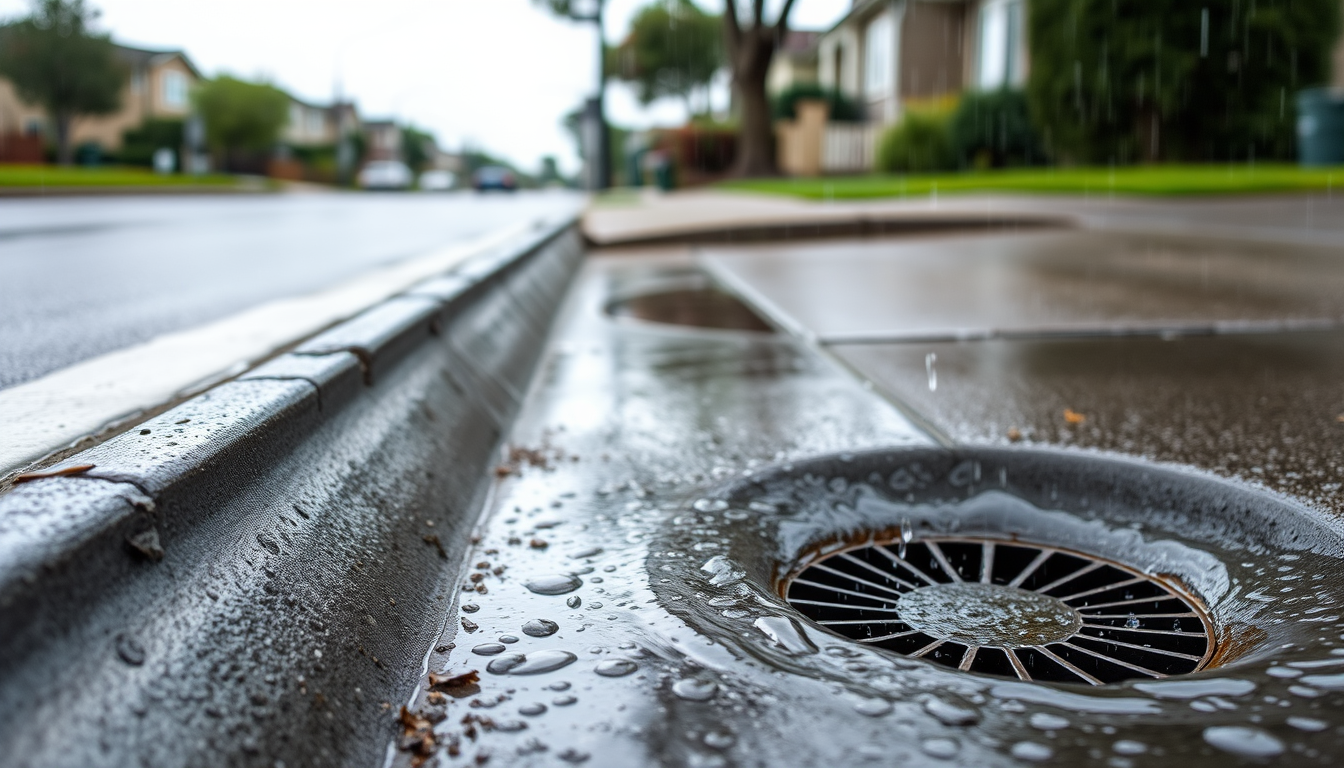
A sewer backup during heavy rain almost always means your line already had a problem. The rain just found it. Roots in a joint, a cracked clay lateral, a bellied section holding water, or a pipe lined with years of grease will pass normal household flow all summer, then fail the first week an atmospheric river parks over the county.
So the real question isn’t why rain causes this. It’s what defect you have and where it sits. Here’s how to tell, what you can check yourself, and what actually prevents a repeat next winter.
Key takeaways
- Rain rarely creates a blockage. It exposes one. The EPA lists tree roots entering through defects, grease and wipes, and storm water leaking in through cracks and bad joints as the main causes of sanitary sewer overflows (US EPA).
- Roots are the biggest single culprit. A USDA Forest Service review found roots cause more than 50% of all sewer blockages (Randrup, McPherson & Costello, 2001).
- In Sonoma County the private lateral is yours. Sonoma Water states the property owner is responsible to clean, maintain and replace it (Sonoma Water).
- If sewage stands in your cleanout, the blockage is downstream of that cleanout. That one check narrows the search fast.
- A camera inspection is the only way to know whether you need a cabling, a jetting, or a repair. Everything else is guessing.
Why does a sewer backup during heavy rain happen?
Two things happen at once in a storm, and both squeeze a pipe that was already compromised.
Rain water gets into a sewer that was never meant to carry it
Sanitary sewers are sized for toilets, showers, and washing machines. Not rainfall. When storm water and groundwater leak in through cracked pipe, offset joints, or a failed connection at the property line, the system carries far more water than it was built for. The EPA puts it plainly: “stormwater, ground water and snowmelt entering the sanitary sewer from cracks and faults in the sewer or leaky sewer joints can overload a sanitary sewer” (US EPA, Sanitary Sewer Overflow Frequent Questions). The trade name for it is inflow and infiltration, or I&I.
Sonoma County sees this at full scale. On January 6, 2026, heavy overnight rain from an atmospheric river drove the Russian River County Sanitation District treatment plant near Guerneville to roughly 4 million gallons per day against a design capacity of 710,000 gallons per day of average dry weather flow. An estimated 5,507,000 gallons spilled (Sonoma Water). That is I&I across an entire collection system. Your lateral is the same physics at house scale.
The rain didn’t break your line. It loaded it.
A partially blocked pipe still drains. Slowly, but it drains, and most homeowners never notice. Add saturated soil pressing groundwater through every crack, plus the whole neighborhood’s flow moving through the main at once, and partial becomes total. That’s why a sewer line backup feels sudden when it has actually been building for years.
Why do Sonoma County laterals fail first?
Older pipe, mature trees, and a wet winter is the local recipe. Why does the same storm flood one house and skip the one next door? Usually because of what’s buried between them. The median Sonoma County home was built in 1980 (Census Reporter, ACS 2024 1-year, Table B25035), and plenty of stock in Santa Rosa, Petaluma, Sebastopol, and Healdsburg is considerably older. Sonoma Water estimates two-thirds of the sewer laterals in Sonoma Valley are at least 30 years old and likely in need of repair (Sonoma Water).
What’s in the ground matters:
- Vitrified clay in pre-1970s homes. Short sections with mortared or gasketed joints every few feet. Every joint is a door for roots.
- Cast iron under the slab and out toward the street. InterNACHI puts below-ground cast iron waste pipe at 50 to 60 years (InterNACHI life expectancy chart). A 1965 house is past that.
- ABS or PVC in newer construction. Better joints, but a poorly bedded run still bellies as clay soil swells and shrinks between wet winters and bone-dry summers.
Then the trees. Local yards are full of mature valley oaks, redwoods, liquidambars, and old fruit trees, and their roots go hunting for exactly what a leaking sewer joint offers: water and nutrients. The Forest Service review of root intrusion reports roots cause more than 50% of all sewer blockages (Randrup, McPherson & Costello, Journal of Infrastructure Systems, 2001). Winter is when a root mass that was only narrowing the pipe finally catches enough paper to close it.
Is the sewer line backup on your property or the city’s main?
Check your cleanout first. If sewage stands in the cleanout riser, the blockage is downstream of it, somewhere between there and the city sewer. If the cleanout is dry while fixtures inside are backing up, the problem is upstream, inside the house. That single observation splits every sewer line backup into two very different jobs, and it takes about thirty seconds.
The cleanout is usually a capped pipe three or four inches across, near the foundation or along the path from the house to the street. Pull the cap slowly and stand to the side. If the line is holding pressure, it will come out at you. Other tells worth noting before you call anyone:
- The lowest fixture floods first. A ground floor tub that fills when you flush a toilet points at the main line, not that fixture.
- More than one fixture is affected. One slow sink is a fixture problem. Toilet plus tub plus washer standpipe is a main line problem.
- The toilet gurgles when the washer drains. Air is being forced past a partial blockage.
- Neighbors on your street have it too. That shifts suspicion to the city main. Call the city or your sanitation district before you pay anyone.
Who owns what? Santa Rosa City Code Chapter 15-16 requires the user to maintain, operate, and repair, at their own expense, the entire sewer service lateral, cleanouts, backwater valves and backflow overflow devices from their premises to the City sewer (City of Santa Rosa Municipal Code). The city may elect to repair the stretch between the main and the back of the curb, but that’s at its discretion, not your right.
What should you do in the first ten minutes of a backup?
Stop adding water. That is the single most useful thing a homeowner can do during a sewer backup, and it costs nothing. Every gallon you send down a blocked line comes back up through the lowest opening in the house, which is usually a ground floor tub, shower pan, or floor drain.
- Shut off the washing machine and dishwasher mid-cycle. They dump the most water the fastest.
- Tell everyone to stop flushing, showering, and running sinks.
- Keep people and pets out of standing sewage. It carries bacteria and viruses. Gloves and boots if you have to be in it.
- If it’s coming up through a floor drain or shower pan, don’t plug it. Blocking the relief point pushes sewage further into the house.
- Photograph everything before cleanup for your insurance carrier.
Once water use stops, a partially blocked line will usually drain down on its own. Does that mean it’s fixed? No. It means you bought a few hours, and the next load of laundry will put you right back where you started.
Which parts of this can you handle yourself?
Honest answer: very little of a sewer backup during heavy rain is a DIY job, and we’d rather say that than sell you something you don’t need. Fixture-level clogs you can handle with a plunger and a hand auger. Anything in the main line needs a cable, a jetter, or a camera.
Reasonable to do yourself: plunge a single toilet, pull and clean a sink P-trap, run a small hand auger through a tub or lavatory drain, find and uncap your cleanout, and keep grease out of the kitchen sink.
Not worth attempting: rented drum machines on a main line. We pull a lot of broken rental cable out of laterals, and a cable that snaps or balls up inside clay pipe turns a routine drain cleaning into an excavation. Chemical root killers and drain openers are worse. They sit on top of a blockage they can’t dissolve, and then somebody has to reach into that.
Call when any of these are true: more than one fixture is backing up, sewage reaches a floor drain or shower pan, the cleanout is full, or this is the second backup in the same rainy season. A repeat in one winter is a structural problem, not a clog.
How does a tech find the actual cause?
A sewer camera inspection settles it. We send a self-leveling camera head down the cleanout, watch the inside of the line on a monitor, then use a sonde and a locator above ground to mark the exact spot and depth of the defect on your lawn or driveway. No guessing about where to dig, because the paint mark is the answer. On a rain-triggered backup we pay closest attention to what the line looks like at joints and at the property line, since that’s where storm water gets in.
What the camera distinguishes is what determines the fix. Four findings account for nearly every sewer backup during heavy rain we’re called out for:
| What the camera shows | What it means | What fixes it |
|---|---|---|
| Roots at a joint | Fine hairs up to a full mat. Tells us whether the joint is still sound or already displaced. | Cabling or hydro jetting on a maintenance interval, or a joint repair if it has shifted |
| Grease and scale coating the wall | The pipe’s usable diameter is shrinking. Common in kitchen branch lines and older cast iron. | Hydro jetting, which scours the wall back to full bore instead of boring a channel through the buildup |
| Standing water in a sagged run | A belly. The pipe has lost its fall, so solids settle instead of flowing. | Re-bedding or replacing that section. No cleaning method fixes a belly. |
| Cracks, offsets, separated joints | The inflow and infiltration pathway. This is the defect that makes a line back up specifically when it rains. | Sewer repair, often trenchless CIPP lining or pipe bursting rather than an open trench |
Buying an older home in Sonoma County or Marin? Run the same camera inspection before you close. A lateral defect found during escrow is a negotiation. Found in February, it’s an emergency.
How do you prevent a sewer backup during heavy rain?
Fix the defect, then protect the house. In that order, because a backwater valve on a root-choked line only moves where the sewage stops.
1. Clear and camera the line before the rains. Late summer through early fall is the window. Dry ground, no urgency, and you learn what you’re dealing with while a repair is still a scheduled job instead of a 2 a.m. one.
2. Handle roots on a schedule, not in a crisis. If the camera shows roots and the joints are still sound, a routine cabling or jetting interval keeps the pipe open. Roots regrow, every time. Anyone promising that one visit ends them permanently is selling you something.
3. Install a backwater valve if your fixtures sit low. A backwater valve is a backflow prevention device that stops wastewater from re-entering a property. Under California Plumbing Code Section 710.1 it’s required where plumbing fixtures sit below the elevation of the next upstream manhole cover (City of Santa Barbara Public Works). If the main surcharges in a storm, that valve is what keeps it out of your ground floor. It needs periodic inspection to keep working.
4. Make sure nothing but sewage enters the lateral. Sump pump discharge and roof runoff piped into a sanitary lateral are illegal cross-connections in most jurisdictions, and the EPA names those inappropriate connections among the causes of sewer overflows. If a previous owner tied one in, disconnect it.
5. Keep grease and wipes out. The EPA specifically names fats, oils and grease along with products “marked ‘flushable'” such as baby wipes and sanitary products. Grease congeals in cold winter soil and catches everything behind it.
6. Add a cleanout if you don’t have one. Some older Sonoma County homes never got a proper exterior cleanout. Without one, every service call starts by pulling a toilet.
Frequently Asked Questions
Can heavy rain alone cause a sewer backup in a healthy line?
Rarely, and only when the municipal main itself surcharges. A sound lateral with tight joints and full diameter handles a storm fine. When rain reliably triggers a backup at one house on the street, the defect is usually that house’s lateral. The EPA lists infiltration through cracks and faulty joints as a primary overload cause, and those cracks sit on private property more often than not.
Why does my toilet gurgle and my shower back up only when it rains?
That combination points to a partial blockage in the main line plus extra water entering it. The gurgle is air forced past a restriction. The shower floods because it’s the lowest opening in the house. In dry weather the line still passes flow, so nothing looks wrong. A camera inspection of the lateral shows whether it’s roots, grease, or a belly holding water.
Is the sewer lateral my responsibility or the city’s in Sonoma County?
Yours, in almost every case. Sonoma Water states that it is the responsibility of the property owner to clean, maintain and replace their private sewer lateral. Santa Rosa City Code Chapter 15-16 requires the user to maintain, operate, and repair the entire lateral, cleanouts, and backwater valves at their own expense. Check with your specific city or sanitation district, since terms differ.
Will hydro jetting fix a sewer backup caused by tree roots?
Often, yes, and it cleans more thoroughly than a cable because a jetter scours the full pipe wall instead of boring a channel through the blockage. But it depends on pipe condition. Jetting a badly cracked or offset clay lateral can make matters worse. That’s why we camera first, then pick the method. Roots regrow, so plan on a maintenance interval.
How soon after a backup should I get the line inspected?
As soon as the line is flowing again, ideally on the same visit. Clearing the clog tells you nothing about why it formed. A camera run right after cleaning shows the pipe wall clearly and separates a maintenance item from a repair. Waiting until the next storm means finding out the hard way.
The short version
Rain doesn’t cause a sewer line backup. It reveals one. In Sonoma County the usual suspects behind a sewer backup during heavy rain are roots at clay joints, cast iron past its service life, a bellied run holding water, and cracks letting groundwater in. All four show up on camera, and all four have a defined fix. What they don’t have is a fix you can guess at from inside the house.
If your drains backed up in the last storm, or you get gurgling toilets and a slow shower every time it rains, that’s the pattern described here and it’s worth putting eyes in the pipe. Call Rock Solid Drains at (707) 889-8191 or get in touch. We’re licensed in California (CSLB #1065909) and work throughout Sonoma County and Marin. You can read what local homeowners say about the work on our reviews page.