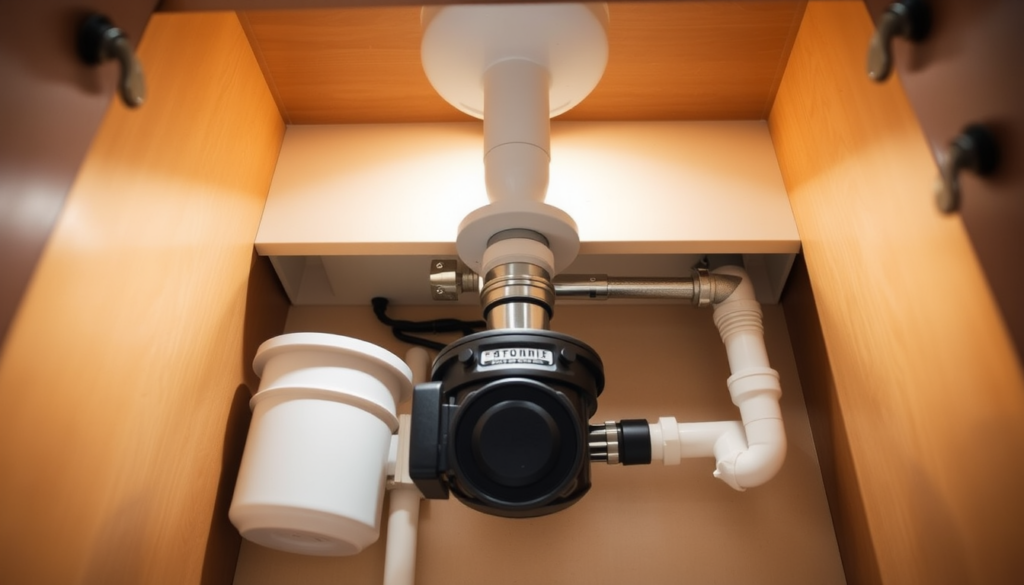
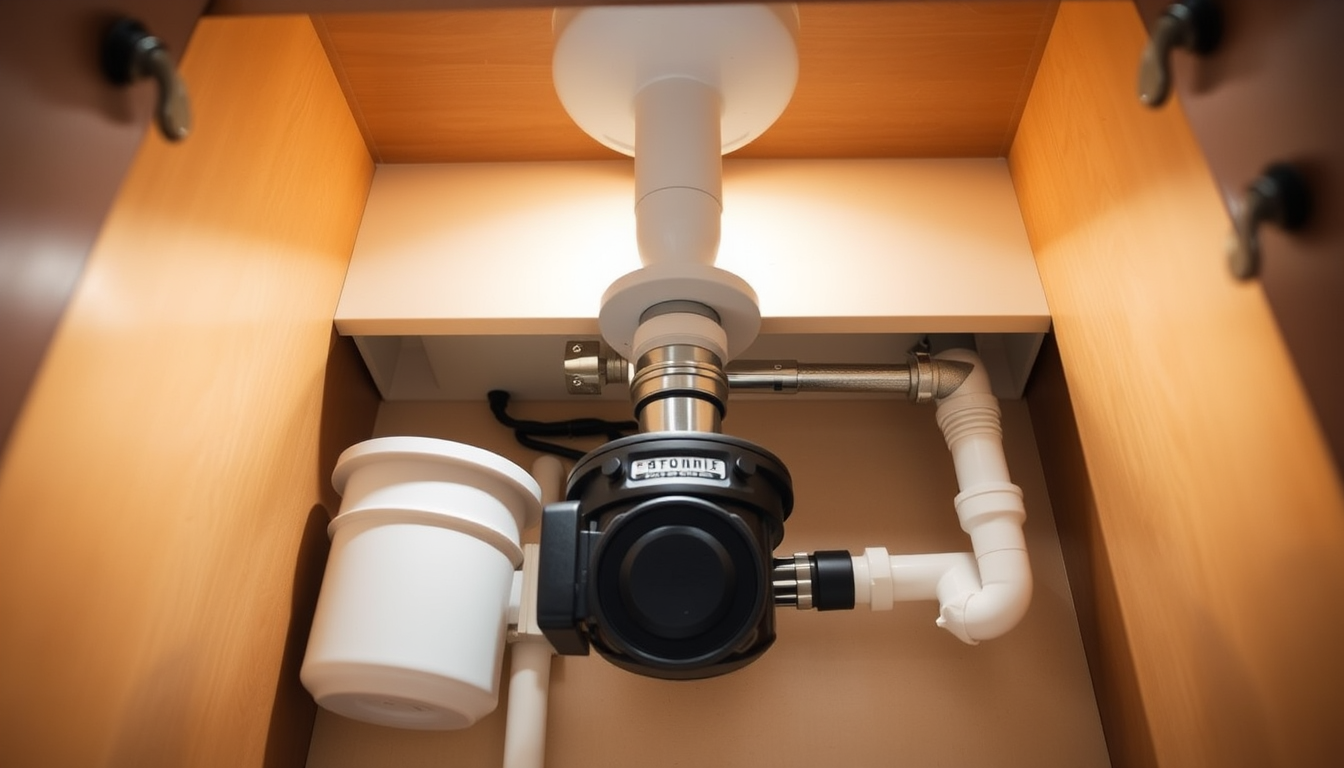
Is your garbage disposal clogged? The first job is figuring out whether the appliance is even the problem. Usually it isn’t. The motor runs fine, the grinding chamber is empty, and water still sits in the sink because the pipe downstream is coated in grease. InSinkErator’s own troubleshooting page gives you the test: run the unit and watch the standing water. See a whirlpool? The disposal is working, and the blockage is past it (InSinkErator, Fixing a Clogged Garbage Disposal). That one observation changes everything you do next.
Key takeaways:
- The whirlpool test sorts it out in ten seconds. Water swirling but not draining means a kitchen drain clog downstream, not a broken appliance.
- Humming without turning means jammed. The documented fix is a 1/4-inch Allen wrench in the center hole on the bottom of the unit.
- Grease is the number one culprit. In its 2004 report to Congress, EPA identified grease from restaurants, homes and industrial sources as the most common cause (47%) of reported sewer blockages.
- Repeat clogs are a pipe problem. If the same sink backs up every few months, the branch line or the sewer lateral needs a camera, not another bottle of drain cleaner.
Is the garbage disposal clogged, or is the drain line past it?
Run the unit and look at the water. A whirlpool means the impellers are spinning and the pipe beyond the disposal is blocked, which InSinkErator tells homeowners to treat as a drain clog rather than an appliance failure (InSinkErator, Fixing a Clogged Garbage Disposal). No whirlpool, no spin, just a hum? That’s a jam inside the chamber.
There’s a third clue people miss. On a double bowl sink, if water rises in the second bowl when the disposal side backs up, the blockage sits past the point where both bowls tie together. Same story if the dishwasher won’t drain at the same time. That’s a line problem. No amount of work on the appliance will touch it.
What should you do first when your garbage disposal is clogged?
Work in this order. Each step is cheap, safe, and rules something out before the next one. These are the same checks a tech runs before reaching for a cable.
- Kill the power at the breaker.
- Humming with no rotation? Free the flywheel with the hex wrench.
- Completely silent? Press the red reset button underneath.
- Spinning but holding water? Plunge it.
- Still holding water? Pull the P-trap.
Cut the power before you touch anything
Switch the unit off and kill the breaker. The manufacturer is blunt about the rest: do not place your hand in the garbage disposal at any time (InSinkErator, Fixing a Jammed Garbage Disposal). Use tongs and a flashlight. No exceptions on this one.
If it hums but won’t turn, free the flywheel
A hum with no rotation means something is wedged against the impellers. Every InSinkErator ships with a self-service wrench: silver, shaped like a little crank, about four inches long. A standard 1/4-inch Allen wrench works if yours went missing. Insert one end into the center hole on the bottom of the unit, work it back and forth until it turns a full revolution, then lift the object out with tongs (InSinkErator, Fixing a Jammed Garbage Disposal).
If it’s dead silent, press the reset button
The overload protector sits on the bottom of the disposal, facing the floor. It’s a red square button, and when it trips it drops about a quarter of an inch (5mm). Press it gently. If it won’t stay up, wait ten minutes and try again, and give the motor up to 20 minutes to cool (InSinkErator, Resetting a Garbage Disposal).
If it spins fine but the sink holds water, plunge it
This is the whirlpool case. Block the second bowl with a stopper so you don’t just push water sideways. Fill the sink with about four inches (10cm) of water, seat a cup plunger over the disposal opening, press down slowly, then pull up hard (InSinkErator). Soft food plugs let go this way. Set grease usually doesn’t.
If plunging fails, pull the P-trap
Bucket under the trap, loosen both slip nuts by hand, drop the trap and look inside. Either the plug is sitting right there, or the trap is clean. A clean trap tells you the clog is further out in the branch line heading for the wall. Reassemble snug, not gorilla tight, then run water before you walk away.
What should never go down a garbage disposal?
Grease tops every list, and it isn’t close. The City of Santa Rosa’s SewerSmart program names cooking oils, sauces and salad dressings, butter and margarine, and fat from meats including bacon grease and ground beef drippings. Blockages, the city notes, are often caused by fats and food scraps poured or washed down the kitchen sink (City of Santa Rosa, SewerSmart). Hot grease pours like water and hardens like candle wax somewhere down the line, well past where you can see it.
The mechanical offenders are a separate category. Roto-Rooter’s keep-out list includes chicken bones, corn cobs, avocado pits, peach pits, peels, eggshells and coffee grounds (Roto-Rooter). Add the two that generate the most callbacks:
- Stringy and fibrous scraps. Celery, artichoke leaves, corn husks and onion skins wrap around the impellers instead of shredding.
- Starches that swell. Rice, pasta and potato peels drink water and turn to paste in the trap arm.
- Anything you’d wipe out of a pan. Pan drippings and congealed sauce belong in the bin, not the drain.
Worth knowing: EPA ranks sending wasted food down the drain as one of the least preferred pathways, because it decays fast in the sewer and generates methane (US EPA, Wasted Food Scale). Your disposal is a backstop for what rinses off a plate, not a second trash can.
Baking soda, vinegar, and drain chemicals on a grease clog
Baking soda and vinegar fizz, and fizzing feels productive. What it actually does is deodorize and loosen light film. It has no meaningful effect on hardened fat lining the inside of a pipe. That’s why the clog returns a week later.
Chemical drain cleaner is worse than useless here. Roto-Rooter’s position is direct: never use chemical drain cleaners, because they corrode the machine and break down its plastic and rubber parts (Roto-Rooter). And if it doesn’t clear the line, you now have a sink full of caustic liquid waiting for whoever opens that trap. Tell your tech if you poured any in. It matters.
When is the real problem the kitchen drain line, not the disposal?
A kitchen drain clog that keeps returning is telling you about the pipe, not about last night’s dinner. Grease doesn’t plug a line in one night. It builds in layers on the pipe wall until the opening is a fraction of what it started as, and then one starchy meal finishes the job. In its 2004 report to Congress, EPA identified grease from restaurants, homes and industrial sources as the most common cause (47%) of reported blockages (US EPA, fact sheet EPA-833-F-12-003).
Local housing stock matters here. As of the 2024 American Community Survey, the median Sonoma County home was built in 1980 (U.S. Census Bureau, table B25035, via Census Reporter), and plenty of what we open up in Santa Rosa, Petaluma and Sebastopol is older than that. On those houses the kitchen branch is often cast iron, and cast iron scales up on the inside as it ages. Grease grabs that rough surface and holds.
Past the branch line, the same grease reaches the sewer lateral, where it meets root intrusion from the mature trees that came with a lot of the older lots around here. When a main clogs from accumulated grease, Santa Rosa notes that wastewater has nowhere to go but out of a manhole or cleanout (City of Santa Rosa, SewerSmart). So if your kitchen backs up at the same time as a tub or a floor drain, stop treating it as a sink problem.
What does a drain tech actually do on a clogged kitchen line?
First a cable, then a decision. The tech opens the nearest cleanout and runs a cable machine out through the branch line with a cutter head sized to the pipe. That reopens flow, and it tells you something by feel. Soft resistance the whole way is grease. A hard stop at a fixed distance is an object, a belly, or roots.
Here’s the honest limitation: cabling a greased line bores a hole through the plug. It does not clean the pipe wall. That’s why a cabled kitchen line can clog again in a season. Hydro jetting scours the fat off the walls with water instead of punching through it, and it’s the right call once a line has been cleared more than once. When something keeps coming back, a sewer camera inspection shows the real condition: scale, a low spot holding water, a cracked joint, or roots.
| Method | What it clears | What it won’t do |
|---|---|---|
| Cup plunger | Soft food plugs sitting near the trap | Touch set grease or anything past the branch line |
| Hex wrench under the unit | A flywheel jammed by a bone, pit, or utensil | Move a blockage in the pipe downstream |
| Pulling the P-trap | A plug caught in the trap itself | Reach a clog further out toward the wall |
| Cable machine (snaking) | Reopens flow through a grease plug, soft blockage, or roots | Clean the pipe wall, so grease rebuilds on it |
| Hydro jetting | Scours grease and buildup off the full pipe wall | Repair a cracked, bellied, or collapsed pipe |
| Camera inspection | Shows scale, low spots, cracked joints, root intrusion | Clear anything on its own |
Why does the choice matter? A cable restores flow the same day, which is what you want at 6pm on a Tuesday. Jetting and a camera answer the longer question of whether that pipe holds up through another winter.
One boundary worth stating plainly. The disposal itself is an appliance. If the motor is dead or the bottom is leaking, that’s an appliance job. What Rock Solid Drains (CSLB License #1065909) handles is everything downstream: drain cleaning from the trap arm out, and sewer line repair when the camera finds pipe that can’t be cleaned back into service.
Habits that keep the kitchen line clear
Run cold water before, during, and for a while after you use the disposal. Cold keeps fat solid, so it gets ground up and carried out instead of coating the pipe on the way down. Hot water melts it and moves the problem somewhere you can’t see it.
The rest is boring, and it works. Pour cooled cooking fat into a container and throw it away. Santa Rosa’s own guidance is to wipe up grease and leftover sauce with a paper towel and put the towel in your curbside green bin or trash bin (City of Santa Rosa, SewerSmart). Scrape plates into the compost bin. Feed the disposal in small batches with the water already running, not all at once after the sink is full.
When should you call a drain company?
Call when the appliance checks out but the water still won’t go. If the disposal spins freely, the reset holds, the plunger did nothing, and the P-trap came out clean, the blockage is in the branch line or beyond. That’s the point where the manufacturer itself points homeowners toward a licensed plumber (InSinkErator, Fixing a Clogged Garbage Disposal). Same answer if this is the second or third clog in that sink this year, or if another fixture backs up alongside it.
If that matches your situation in Sonoma or Marin County, Rock Solid Drains (CSLB License #1065909) can cable it, jet it when grease keeps rebuilding, and put a camera down the line to show you what’s actually there. Call (707) 889-8191, or read what other homeowners here have said about the work first.
Frequently Asked Questions
Why is my garbage disposal clogged but the motor still runs?
Because the blockage is downstream of the appliance. InSinkErator’s test is to run the unit and look for a whirlpool in the standing water. If the water swirls but doesn’t drain, the impellers are turning and the clog sits in the drain line past the disposal (InSinkErator). Plunge it first, then pull the P-trap.
Can I use Drano or a chemical drain cleaner in a garbage disposal?
No. Roto-Rooter’s guidance is to never use chemical drain cleaners in a disposal, because the chemicals corrode the machine and break down its plastic and rubber parts (Roto-Rooter). They also rarely clear a grease plug, which leaves caustic liquid standing in the sink for whoever opens the trap next.
Does baking soda and vinegar actually unclog a garbage disposal?
It helps with odor and light film, not with a real blockage. Hardened fats coat the inside of the pipe, and a fizzing reaction up in the sink basin doesn’t reach or dissolve them. If the sink drains slowly again within a week or two, the pipe wall is still coated and the line needs mechanical cleaning.
Why does my kitchen sink keep clogging every few months?
Recurring clogs point at the pipe, not the food. Grease builds in layers until the opening narrows, and in its 2004 report to Congress EPA identified grease as the most common cause (47%) of reported blockages (US EPA). In older Sonoma County homes, scaled cast iron branch lines and root intrusion in the lateral make it worse. A camera inspection tells you which one you have.
Is it safe to put my hand in the garbage disposal to pull something out?
No. InSinkErator’s instruction is to make certain the switch is off and do not place your hand in the garbage disposal at any time (InSinkErator). Kill the breaker, use a flashlight, and retrieve objects with tongs or needle nose pliers. Free a jammed flywheel with the hex wrench from underneath instead.
Sources
- US EPA, Office of Water, “Controlling Fats, Oils, and Grease Discharges from Food Service Establishments,” EPA-833-F-12-003, September 2012, citing EPA-833-R-04-001, August 2004. Retrieved 2026-08-10. epa.gov
- US EPA, “Wasted Food Scale.” Retrieved 2026-08-10. epa.gov
- City of Santa Rosa, “SewerSmart.” Retrieved 2026-08-10. srcity.org
- InSinkErator Support, “Fixing a Clogged Garbage Disposal,” “Fixing a Jammed Garbage Disposal,” and “Resetting a Garbage Disposal.” Retrieved 2026-08-10. support.insinkerator.com
- Roto-Rooter, “What Can I Do to Fix a Clogged Garbage Disposal?” Retrieved 2026-08-10. rotorooter.com
- U.S. Census Bureau, American Community Survey 2024 1-year estimates, table B25035 (Median Year Structure Built), Sonoma County, CA. Retrieved 2026-08-10. censusreporter.org