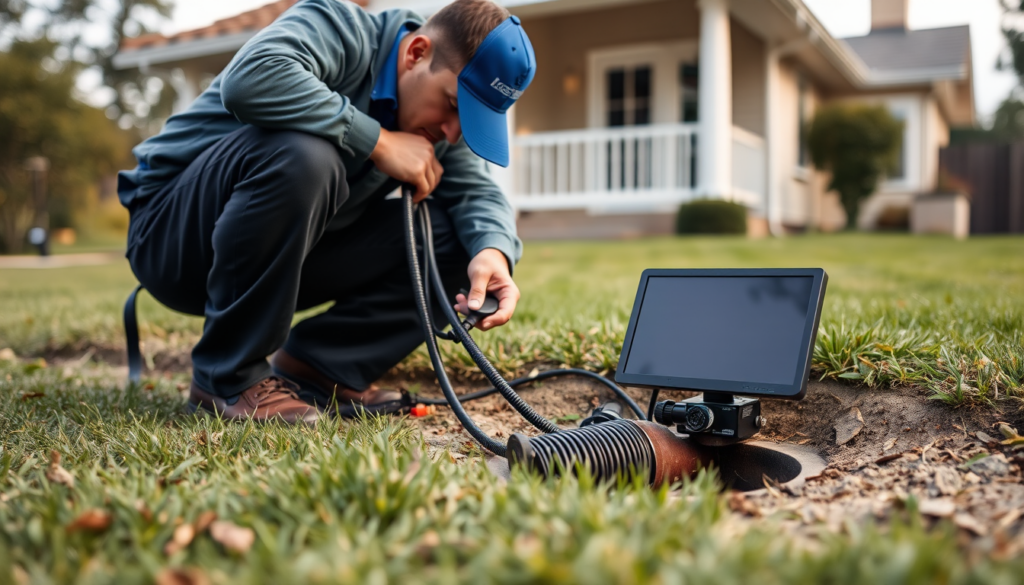

A Sewer Lateral Inspection is a recorded camera survey of the private pipe that carries wastewater from your house to the public sewer main. A technician feeds the camera in through a cleanout, runs it out toward the street, and notes every root, crack, sag, and offset joint along the way. In Sonoma County and Marin, some owners book one because a drain keeps backing up. Others book one because their sanitary district says they have to.
Which group are you in? Stand at the cleanout with us for a few minutes. You’ll see what the camera looks for, how the footage gets graded, and whether a local rule applies to your property.
Key Takeaways
- A sewer lateral inspection is a video run from the cleanout to the public main.
- NASSCO grades each pipe defect from 1 (minor) to 5 (most significant).
- Sonoma Valley County Sanitation District treats a lateral rated 4 or 5 as failing and allows one calendar year for repairs.
- Several Marin districts require an inspection at sale or after a remodel above a set dollar amount.
What Is a Sewer Lateral Inspection?
A sewer lateral inspection is a closed-circuit television (CCTV) recording of the inside of your building sewer, from the cleanout near the foundation to the point where it joins the district’s system. That’s the scope the Sausalito Marin City Sanitary District sets for plumbers who submit compliance video.
Why does this one pipe get so much attention? Because it’s usually yours. The City of Santa Rosa’s Water and Sewer page puts it plainly. The user shall “maintain, operate, and repair, at user’s own expense and after obtaining all required permits, the entire sewer service lateral.” The city may choose to repair only the stretch between its sewer and the back of the curb or sidewalk.
A general home inspector won’t see any of this, since the lateral is buried. The only honest way to judge it is to put a camera inside, which is the whole job of a sewer camera inspection.
How Does a Sewer Lateral Inspection Work?
A sewer lateral inspection follows the same order on nearly every property: find access, make sure the camera can travel, record the run, and hand over the footage. Here’s how that plays out on a typical visit.
- Find the access point. Most runs start at a cleanout near the foundation. Some older Sonoma County homes don’t have a usable one, and that changes the plan.
- Make sure the line is passable. A camera can’t read a pipe packed with roots or grease. If it stalls, the line may need drain cleaning before a second pass.
- Record the full length. The camera travels toward the main while the tech watches the monitor and tracks how far out it is.
- Log and locate defects. Each root, crack, or sag gets noted by distance. A locator can then mark that spot on the ground.
- Deliver the video. Several Marin districts accept footage only through an online review portal, so the format matters.
The recording has to be good enough for someone else to judge. Sausalito Marin City Sanitary District says “Poor quality videos which do not allow for proper inspection will be rejected.” Tamalpais Community Services District requires video through the Go Forward Lateral platform starting March 1, 2026, and says no other method will be accepted.
Can you skip the cleaning and just look? Sometimes. But when the camera stops at a root ball on the first joint, you’ve learned almost nothing about the rest of the line.
What Does the Camera Look For?
The camera looks for four things: roots, structural cracks and breaks, sags that hold water, and the pipe material itself. The City of Santa Barbara’s lateral program sums up the usual failures as “tree roots entering at failed joints or cracks, broken or separated joints, or complete collapses.”
Tree roots at the joints
Roots rarely punch through sound pipe. They find a joint that has opened and follow the moisture in. When we push a camera down an older clay lateral, the joints are the first thing we watch. Fine roots look like hair. A mature root mass can fill the pipe wall to wall.
Cracks, fractures, and offsets
A crack is a line that isn’t open yet. A fracture has opened. A break means pieces have shifted out of place. An offset joint shows up as a ledge where one section no longer lines up with the next, and it’s a favorite snag point for paper and grease.
Bellies and standing water
A belly is a low spot where the pipe has settled. On the monitor, the lens dips into water, or a steady waterline sits where the pipe should drain dry. Solids collect there, so bellied lines tend to clog again soon after cleaning.
Pipe material
Material tells you which failures to expect. Santa Barbara notes that laterals on pre-1970 homes are “most likely made from clay, cast iron or ‘orangeburg’ and may need to be repaired, rehabilitated or replaced.” Clay opens at the joints. Cast iron corrodes and scales from the inside, and on camera we see that scale as a rough, lumpy crust that narrows the pipe. Orangeburg, a fiber pipe, can squash out of round.
How Do Districts Grade a Lateral?
Sonoma Valley County Sanitation District rates laterals from 1 to 5 and asks for outside reports that meet NASSCO standards. NASSCO (the National Association of Sewer Service Companies) grades each defect from 1 to 5, with 5 the most significant, as explained in its June 2016 Tech Tips article on PACP condition grades. Its Lateral Assessment Certification Program (LACP) standardizes how lateral defects get coded.
The grade comes from the defect code, not the operator’s opinion. NASSCO’s example follows one crack as it gets worse:
| Grade | NASSCO code | What the camera shows |
|---|---|---|
| 2 | Crack Longitudinal (CL) | A lengthwise line that isn’t visibly open |
| 3 | Fracture Longitudinal (FL) | The same crack, now visibly open |
| 4 | Broken (B) | Pipe pieces displaced from their original position |
| 5 | Broken, soil or void visible | A break with soil or an empty cavity showing behind the wall |
How many defects matters as much as how bad each one is. In July 2023, NASSCO’s PACP Condition Grading System tech tip said four or more structural defects may suggest full-length attention, while one or two may suggest a localized repair.
A grade has limits, though. NASSCO’s 2016 article says condition grades can’t account for material, voids, and other conditions outside the pipe, and “cannot take the place of an engineer’s judgement.” Reading the footage still takes someone who has watched a lot of pipe go by on a monitor.
When Do Sonoma County and Marin Rules Require a Sewer Lateral Inspection?
The rules change from one district to the next. Each agency below sets its own triggers, so whether you need a sewer lateral inspection depends on which district serves your address. The table below pulls each requirement from the agency’s own published page.
| Agency | What triggers an inspection | Deadline, exemption, or validity |
|---|---|---|
| Sonoma Valley County Sanitation District | Property 30 years or older | Rated 4 or 5: one calendar year to repair |
| Ross Valley Sanitary District | Buying or selling, remodeling over $75,000, or adding a bathroom | 90 days from close of escrow after a sale |
| Sanitary District No. 5 of Marin County | Sale, more than $50,000 of work within 3 years, or a nearby sewer main or road resurfacing project | Exempt if the lateral was installed or replaced within 20 years |
| Sausalito Marin City Sanitary District | Resale, change in customer, remodel over $50,000, or change in use | Required if not inspected or replaced in the last 10 years |
| Tamalpais Community Services District | Title transfer, or improvements of $40,000 or more over the prior three years | Certificate valid 3 years, up to 10 depending on improvements |
Sonoma County
Sonoma Water says owners of property 30 years or older in the Sonoma Valley County Sanitation District must have laterals inspected and repaired if necessary. A rating of 1 to 3 isn’t failing and earns a letter of compliance. A rating of 4 or 5 is failing, and the owner gets one calendar year to repair it with a qualified contractor. The District offers to run the video. Owners who decline may have to hire a company whose report meets NASSCO LACP standards.
Santa Rosa is different. The city page cited above puts the whole lateral on the owner, so whatever the camera finds is yours to fix.
Marin County
Ross Valley Sanitary District serves Larkspur, Ross, San Anselmo, Fairfax, and nearby unincorporated areas, and it witnesses a pressure test before it verifies compliance. Sanitary District No. 5 sets its triggers in Ordinance 2014-02a. Buying or selling in Marin? Call the district before you set a closing date, because a 90-day compliance clock is easy to lose track of in escrow.
Who Should Get One Even Without a Rule?
Plenty of owners should get a lateral inspection even when no ordinance applies. Home age is the first filter. The City of Santa Barbara says laterals on pre-1970 homes are most likely clay, cast iron, or Orangeburg, and Sonoma Valley County Sanitation District draws its own line at properties 30 years or older. The camera earns its keep if any of these sound familiar:
- You’re buying an older home with clay or cast iron sewer pipe and big trees near the line.
- The same drain has needed clearing more than once, which often points to roots, a belly, or an offset.
- Sewage comes up in the lowest fixture in the house, like a shower or floor drain.
- Someone has quoted you a sewer repair and you want to see the defect before agreeing to the fix.
What Can You Check Yourself First?
You can rule out a few things before calling anyone. Santa Barbara’s lateral program lists the warning signs owners can spot themselves: sewage backups, slow drainage, and patches of yard that stay wet. Is only one fixture slow? That’s usually a clog in that fixture’s branch, not the lateral. If every drain slows at once, or a toilet gurgles when the washer empties, the trouble is further downstream.
Next, find your cleanout and look at the cap. Water standing in it, or a cap that weeps, means the line is backed up past that point. Don’t pull the cap on a backed-up line, since it can dump sewage into your yard. At that stage a camera tells you far more than another bottle of drain cleaner.
What Happens If Your Lateral Fails?
A failing lateral gets repaired or replaced, and the footage decides which. In the Sonoma Valley County Sanitation District, a grade of 4 or 5 starts a one calendar year clock to make repairs with a qualified contractor. One or two localized defects may only need a spot repair. Heavy roots may need hydro jetting before the pipe can be judged at all. Several structural defects along the run usually point toward sewer repair or full replacement, sometimes trenchless if the pipe qualifies.
Facing a district deadline, a sale, or a drain that won’t stay clear? Call Rock Solid Drains at (707) 889-8191 (CSLB License #1065909). We’ll run the camera and walk you through the footage. If your drains are fine and no rule applies, you probably don’t need us yet. You can read what neighbors say on our reviews page or reach us through the contact page.
Sources Used in This Article
Each rule and grade above was checked against these pages, retrieved September 14, 2026:
- Sonoma Water, Sonoma Valley private sewer lateral inspection page
- City of Santa Rosa, Water and Sewer page
- Ross Valley Sanitary District, Compliance
- Sanitary District No. 5 of Marin County, Permits and Sewer Lateral Inspections
- Sausalito Marin City Sanitary District, Sewer Lateral Compliance Certificates
- Tamalpais Community Services District, Sewer Lateral Inspection and Repair
- NASSCO, Tech Tips: PACP Condition Grades and Their Proper Application (June 2016)
- NASSCO, PACP Condition Grading System (July 2023)
- NASSCO, PACP, LACP, MACP
- City of Santa Barbara, Sewer Lateral Inspection Program
Frequently Asked Questions
Is a sewer lateral inspection the same as a sewer scope?
In practice, yes. Both run a camera through the building sewer and record its condition. The difference is usually paperwork. A district compliance inspection may need a set format and an upload to the district’s review portal. A buyer’s sewer scope is for your own decision.
Does a camera inspection show leaks outside the pipe?
Not directly, because the camera only sees the inside wall. NASSCO notes that condition grades can’t account for voids and other conditions outside the pipe. That’s one reason Ross Valley Sanitary District witnesses a pressure test before verifying compliance instead of relying on video alone.
How long is a sewer lateral inspection good for?
It depends on the district. Tamalpais Community Services District certificates are valid for 3 years and can extend up to 10. Sausalito Marin City Sanitary District requires a new inspection if the lateral hasn’t been inspected or replaced in the last 10 years.
What grade fails a lateral in Sonoma Valley?
A rating of 4 or 5. Sonoma Water says laterals rated 1 to 3 show damage but aren’t failing, and they receive a letter of compliance. Laterals rated 4 or 5 are failing, and the owner has one calendar year to repair them using a qualified contractor.
Who pays for lateral repairs in Santa Rosa?
The property owner, for the most part. The City of Santa Rosa says the user maintains and repairs the entire sewer service lateral at their own expense, after getting the required permits. The city may choose to repair the section between the city sewer and the back of the curb or sidewalk.