
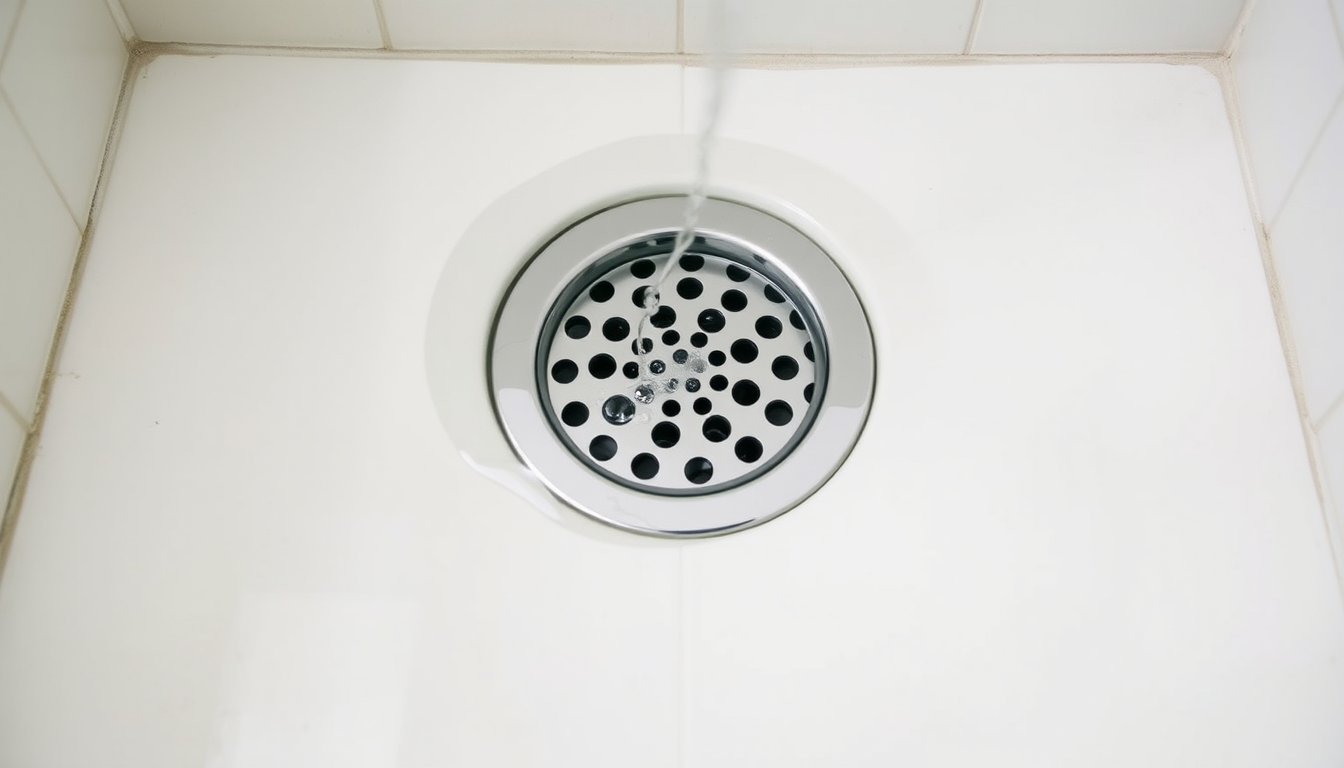
A slow draining shower is almost always a mat of hair bound together with soap scum, sitting in the trap or the first few feet of pipe past it. That’s the common case, and you can often clear it yourself in about twenty minutes. The expensive case is the other one, where the shower is just the fixture that showed the symptom first and the real restriction sits downstream, in the branch line or the main sewer lateral under the yard.
Telling those two apart takes five minutes and no tools. Do that before you buy anything or pour anything.
Key takeaways:
- Hair plus soap scum is the default cause. The mat catches everything that comes down after it.
- Only the shower is slow? The blockage is local. Toilet gurgling or tub slow too? It’s downstream and shared.
- California code sets the minimum shower drain and trap at 2 inches, so a modest coating cuts flow noticeably.
- A shower that slows again within months isn’t a hair problem. Something structural is holding debris.
What Causes a Slow Draining Shower?
Roughly nine times out of ten, it’s hair and soap residue combining into a flexible mat inside the trap or the horizontal arm just past it. Everything else is the minority, and the minority is where homeowners lose money guessing.
Hair and Soap Scum: The Default Cause
The American Academy of Dermatology puts normal shedding at 50 to 100 hairs a day, and a good share of that leaves your head in the shower. On its own, hair would mostly wash through. The soap is what turns it into a blockage.
Here’s the chemistry, and it matters for the fix. Calcium and magnesium ions in hard water react with soap to form insoluble compounds like magnesium stearate, which Chemistry LibreTexts identifies as soap scum. It doesn’t dissolve. It precipitates out and grabs the nearest solid surface, which in your plumbing means the pipe wall and whatever hair is already caught there. Local water makes it worse: the City of Santa Rosa reports average hardness of 5.5 grains per gallon, classified as moderately hard, and wells toward Sebastopol, Penngrove, and Glen Ellen run harder still.
Now put numbers on the pipe. California requires a minimum 2-inch shower drain and trap under Plumbing Code Table 702.1 (City of Rancho Palos Verdes Building and Safety), and showerheads sold here since July 1, 2018 are capped at 1.8 gallons per minute at 80 psi under Title 20. A steady 1.8 gallons a minute has to fit through a 2-inch opening. Line that opening with a quarter inch of scum and hair and you’ve lost most of it.
The Causes People Miss
When it isn’t hair, it’s usually one of these. A razor cap or shampoo lid sits in the trap and becomes a strainer that catches everything after it. Older cast iron grows internal rust nodules, and that rough surface holds debris smooth ABS would flush right through. A section settled out of pitch, what we call a bellied line, meaning a length of pipe that has sagged below its intended slope, ponds water and lets solids drop out. A blocked vent starves the drain of air, so water crawls instead of flows. And out at the lateral, roots can be doing the restricting while the shower takes the blame.
Is It Just the Shower, or Is It the Whole House?
This is the most useful test you can run, and it’s free. A slow draining shower tells you a restriction exists but not where it lives, and fixtures that share a pipe share symptoms. If the shower is the only slow drain, the restriction is upstream of wherever that line joins anything else, meaning the trap or its branch. If more than one fixture reacts, it sits downstream of the point where their pipes meet.
Run this in order and write down what happens:
- Run the shower alone for three minutes. Water pooling around your ankles while the rest of the house behaves points to a local hair mat.
- Fill the bathroom sink and pull the stopper. If the sink empties fine and the shower doesn’t, they aren’t sharing the problem.
- Flush the toilet and listen at the shower drain. Gurgling means air is being pushed through a line they share. That is not a hair mat.
- Run the washing machine through a drain cycle. Biggest single discharge in most homes. If the shower fills during a wash cycle, the main line is restricted.
Why does the shower complain first? It sits lower than every other fixture in the bathroom and runs the longest sustained flow of anything except the washer. When a shared line backs up, water finds the lowest opening. That’s your shower pan.
The rule a tech works from: a symptom that appears in one fixture is a local problem, and a symptom that appears in two or more fixtures is a shared-pipe problem. Because a 1.8 gallon per minute shower runs far longer than a toilet flush, it is often the first fixture to expose a restriction in the sewer lateral, the single privately owned pipe carrying all household waste out to the city main.
What Can You Safely Try Yourself?
If the test says the trouble is local, pull the strainer, usually two screws or a quarter turn, and shine a light down. Most of the time the mat is within the first few inches.
Use a barbed plastic hair tool or needle-nose pliers to pull the mass out rather than push it down. Pulling removes it. Pushing relocates it somewhere harder to reach. Follow with several minutes of hot tap water to soften the film left on the pipe wall, but skip the boiling kettle: ABS and PVC have real temperature limits, and a hairline crack inside a wall is a far bigger job than what you started with. If the mat is out of reach, a short hand-crank auger is the next step.
What to Skip
Chemical drain cleaner is the one product worth arguing about. Sodium hydroxide, the active ingredient in most of them, causes severe skin burns and eye damage and reacts violently with water, according to the Canadian Centre for Occupational Health and Safety. It won’t dissolve a compacted hair mat and does nothing whatsoever to roots or a sagging pipe. What it does is leave caustic liquid standing in your trap for whoever opens that drain next.
Baking soda and vinegar deserves an honest answer too. It fizzes because an acid and a base neutralize each other, and the reaction is over in seconds. Harmless, mildly deodorizing, and useless against hair or metallic soap.
How Do Pros Clear a Slow Draining Shower for Good?
The method depends on where the restriction sits and what the pipe is made of, which is why a good tech asks the same triage questions you just ran through. Three tools cover almost every case.
| Method | What it does | When it’s the right call |
|---|---|---|
| Cabling (snaking) | Feeds a flexible cable with a cutting or retrieving head through the line to break up and pull back the mass | A shower drain clog confined to the trap or branch arm |
| Hydro jetting | Pulls a high-pressure hose through the line and scours the pipe wall back toward bare pipe | Lines coated with years of scum and grease, or repeat blockages after cabling |
| Camera inspection | Sends a video head down the line and locates defects from the surface | Any drain that keeps returning no matter what was used on it |
Cabling has a limitation worth understanding. A cable punches a hole through the obstruction. It does not scour the wall of the pipe. On a heavily coated line you get flow back that afternoon and the same slow shower a few months later, which is when hydro jetting earns its keep. For a straightforward local mat, cabling is faster and cheaper, and it’s what our drain cleaning service handles daily.
When a drain returns regardless of method, stop guessing and look. A sewer camera inspection shows what a cable can only feel: a belly holding water, a cracked hub, offset joints, scaled cast iron, or a curtain of roots. It also pinpoints the defect from above ground, so if a repair is needed you know where and how deep before anyone breaks soil.
The distinction that decides the outcome: cabling bores a channel through a blockage, while hydro jetting removes the material coating the pipe wall. On a California shower line, where code sets the minimum drain and trap at 2 inches, restoring the last quarter inch of that diameter is what separates a drain that stays open from one that slows again by winter.
When Does a Slow Shower Mean a Sewer Line Problem?
Three signs together point past the bathroom and out to the lateral: more than one fixture is slow, the lowest drains act up first, and clearing the shower buys you weeks instead of years.
Roots are the usual culprit around here, and the research backs that up. A US Forest Service review by Randrup, McPherson, and Costello found that roots are reported to cause more than 50 percent of all sewer blockages, naming older jointed pipe, shallow burial, and small-diameter lines as contributing factors. That describes a lot of Sonoma County housing stock exactly: vitrified clay and cast iron laterals joined in short sections, mature oaks and redwoods overhead, and soil that moves between our wet winters and dry summers.
Roots don’t need a broken pipe. They find the hair-thin gap at a shifted joint, follow the moisture in, and fan out into a mesh that catches every bit of hair and paper going by. That same review notes root removal runs about one-sixth the cost of pipe replacement or renewal caused by roots, which argues for cutting them on a schedule once you know they’re there. When the pipe itself is the problem, sewer repair options include trenchless methods like pipe bursting and cured-in-place lining, which rebuild the lateral without trenching the whole yard.
How Do You Keep It From Coming Back?
Put a hair catcher over the drain and empty it. Unglamorous, and the highest-return thing on this page. Brush long hair before you get in. Run hot water for a couple of minutes once a week so the scum film never sets up. On a private well with hard water, treating it helps your plumbing as much as your fixtures.
Prevention works because it attacks the two inputs. A household sheds 50 to 100 hairs per person per day by the American Academy of Dermatology’s figure, and Santa Rosa water averages 5.5 grains per gallon of hardness. A hair catcher removes the first input at the drain opening, and a weekly hot water flush keeps the second from hardening into scum on the pipe wall.
Then watch the interval. Needing a shower line cleared every few years is normal wear. Every few months means something structural is holding debris, and the answer is finding that defect, not clearing the same mat again.
If what you’re seeing matches this article, especially the whole-house symptoms, give Rock Solid Drains a call at (707) 889-8191. We’re licensed in California (CSLB #1065909) and we work throughout Sonoma County and Marin. You can read what local homeowners say or reach out here.
Frequently Asked Questions
Why is my shower draining slowly but not completely clogged?
A partial restriction means the opening is narrowed, not sealed. Water still gets past, just slower than the showerhead delivers it, so it pools around your feet. The usual version is a hair and soap mat that leaves a channel through the middle. Act early, because the mat keeps collecting debris and a slow drain eventually becomes a stopped one.
Is Drano safe for a shower drain clog?
We advise against it, and the reason is what happens after it fails. Product that didn’t clear the mat stays pooled in the trap, so the next person to open that drain gets a face full of it. The Canadian Centre for Occupational Health and Safety lists sodium hydroxide, the active ingredient in most of these products, as causing severe skin burns and eye damage. Mechanical removal takes the mass out instead of leaving a hazard behind it.
How do I know if the clog is in the shower or the main sewer line?
Check whether other fixtures react. If the shower is slow and everything else drains normally, it’s local to that trap or branch. If flushing a toilet makes the shower gurgle, or the shower backs up while the washing machine drains, those fixtures are talking to each other through a shared line and the restriction sits downstream of where their pipes join. That’s a main line symptom, and it calls for a camera rather than a hand auger.
Does hard water really cause slow shower drains in Sonoma County?
It contributes. The City of Santa Rosa reports average hardness of 5.5 grains per gallon, classified as moderately hard, and many rural properties on wells run harder. Calcium and magnesium react with soap to form insoluble compounds that won’t rinse away, so they coat the pipe wall and give hair something to cling to. Hard water doesn’t block a drain by itself. It makes every other blockage form faster.
How often should a shower drain need professional cleaning?
There’s no fixed schedule, and the interval itself is the diagnostic. A household with long hair might have a slow draining shower cabled every few years, and that’s ordinary. If the same drain needs attention every few months, cabling is treating a symptom. A camera inspection becomes the cheaper move, because it tells you whether you’re dealing with scaled cast iron, a bellied section, or root intrusion in the lateral.