By the Rock Solid Drains team, a licensed drain cleaning and sewer repair company in Santa Rosa, CA (CSLB License #1065909) serving Sonoma County and Marin. Owner Casey Post started at his father’s drain company in San Diego in 2002 and, per our About page, managed and ran its jetting and lining divisions for more than 17 years. Updated October 9, 2026.
Tree Roots in Sewer Line, the short answer: roots get in through an opening that was already there, usually a cracked or shifted joint in an older clay or cast-iron lateral (the sewer line from your house to the main). Cutting them out gets the line flowing again. It doesn’t close the opening, so they come back. What lasts is fixing the pipe.
Below, you’ll find how to tell if roots are your problem, what each fix buys you, and what’s worth trying before you call anyone. Every figure and quotation comes from a named public source, and the full list is at the bottom.
Key takeaways:
- Roots don’t break into sound pipe. They follow moisture to a crack or joint that’s already leaking.
- Roots are reported to cause more than 50% of all sewer blockages, according to a 2001 review hosted by the USDA Forest Service.
- Cutting or jetting clears the line, not the entry point. Only a pipe repair stops regrowth.
- Copper sulfate root killer is prohibited for sewer use in Sonoma and Marin counties.
Backing up right now? Stop running water in the house first. Every flush and every load of laundry has nowhere to go.
How Do Tree Roots Get Into a Sewer Line?
Tree roots get into a sewer line by following moisture to a defect that already exists. They don’t drill through sound pipe. The trade calls it root intrusion: live roots growing into a drain or sewer pipe through a crack, a break, or a loose joint.
What draws them in? Warm wastewater pushes vapor out of any gap, and the City of Traverse City’s sewer department explains that roots “follow the vapor trail to the source of the moisture, which are usually cracks or loose joints in the sewer pipe” (City of Traverse City, Tree Root FAQ).
Writing for N.C. Cooperative Extension in 2023, urban forester Keith O’Herrin says tree roots “cannot create cracks in your sewer pipe” and “can only exploit existing cracks or gaps.” In his words, “you had a leaking sewer pipe before the tree roots got there” (N.C. Cooperative Extension, Tree Roots and Sewers). So the tree is the symptom. The opening is the problem.
A city sewer crew tells it the same way. The City of Bismarck’s Public Works Department calls it a misconception that the tree caused the damage: “In most cases the sewer line has a defect in it to begin with allowing the tree roots to enter the line” (City of Bismarck, Sewer Lines and Trees).
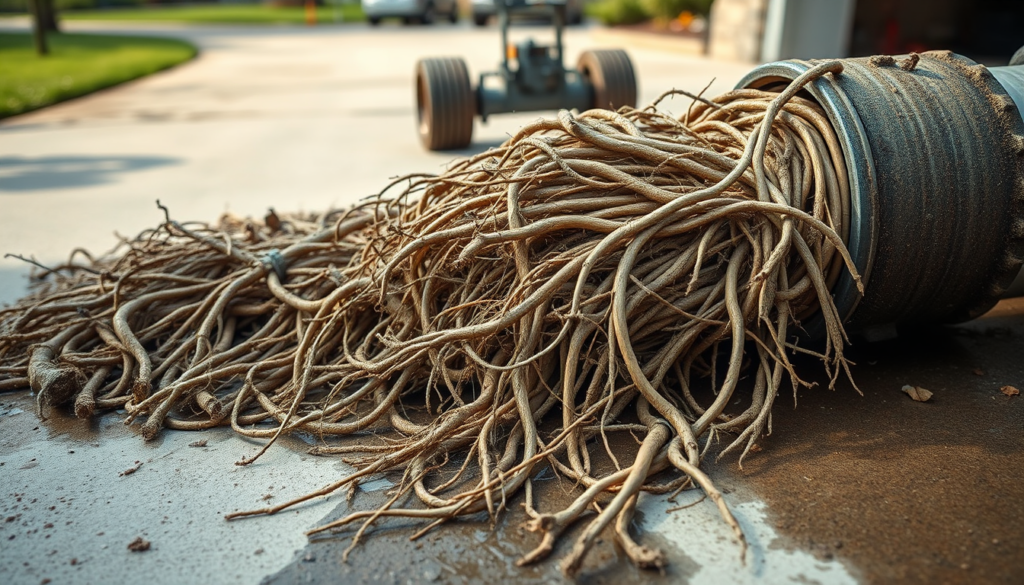
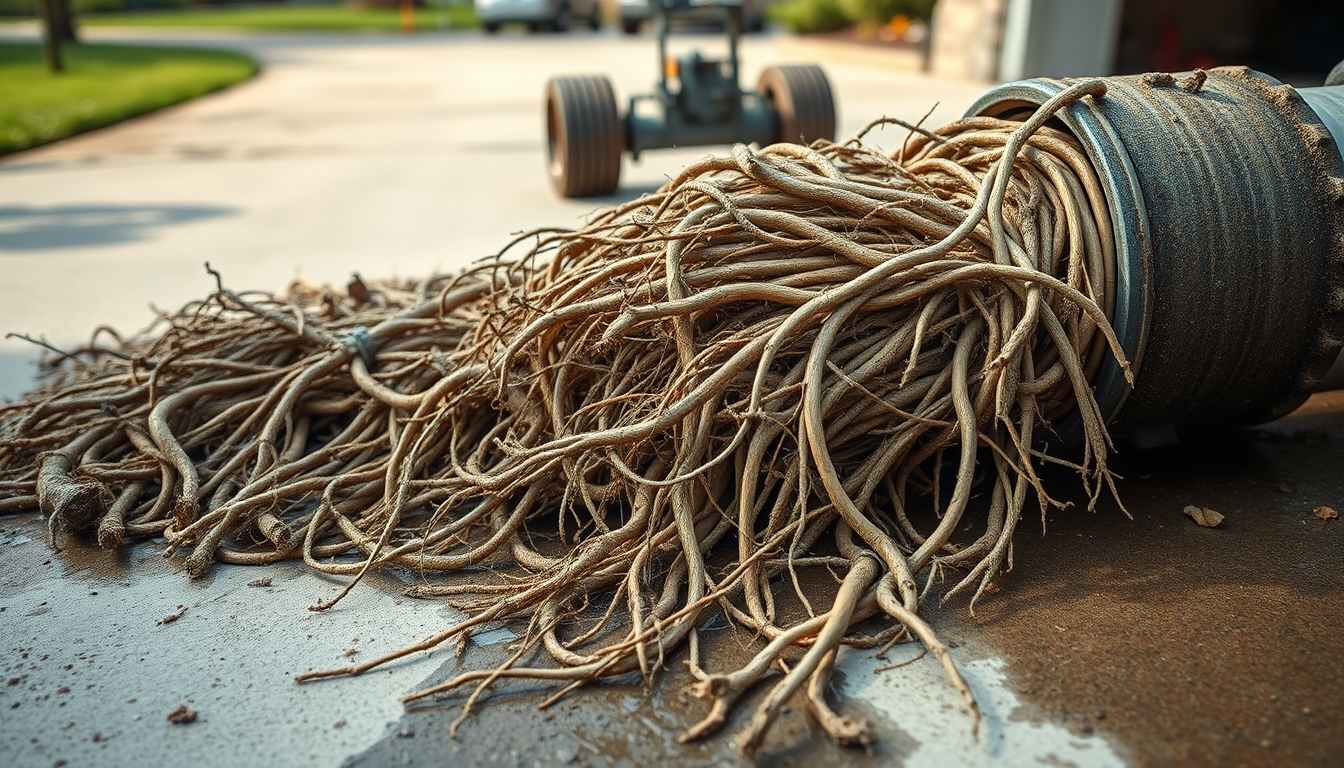
Once a hair root is inside, it branches into a mass that gets, in Traverse City’s words, “matted with grease, tissue paper, and other debris.” That’s the clog you feel at the toilet. Does it let up in winter? No. The same FAQ says root growth “continues in winter even though trees appear to be dormant.”
Which pipes get roots first?
Old, jointed, shallow, small pipe gets roots first, and that’s a fair description of many older house laterals. A 2001 review in the Journal of Infrastructure Systems lists the risk factors as “old pipes with joints, shallow pipes, small-dimension pipes, and fast-growing tree species” (USDA Forest Service, Tree Root Intrusion in Sewer Systems).
Clay is the usual suspect. Bismarck notes that many older clay lines are “cracked or broken, or the joints will have shifted due to soil settlement.” Plastic does better. Traverse City says PVC “is more resistant to root intrusion because it usually has fewer joints.” A poorly sealed joint can still let roots in.
What Are the Signs of Root Intrusion in a Sewer Lateral?
The clearest sign of root intrusion in a sewer lateral is a main-line clog that keeps coming back. That 2001 review, hosted by the USDA Forest Service, says roots are reported to cause more than 50% of all sewer blockages. One slow sink is a sink problem. Roots sit in the lateral, downstream of everything, so they show up at more than one fixture.
Traverse City’s sewer department says the first signs are “gurgling noises from toilet bowls” and “wet areas around floor drains after completing the laundry.” Watch for these:
- The toilet gurgles when the tub or the washer drains.
- Several fixtures run slow at once, and the lowest ones are the worst.
- The line was cabled, ran fine for months, then plugged again the same way.
- The cable or cutter comes back with roots on it.
Ask to see what came out. Fine, hairlike roots are how an intrusion starts. Thick, woody pieces have been growing in that joint a good while.
What you probably won’t see is anything in the yard. Sonoma Water says “most people won’t see a problem at the ground surface” (Sonoma Water, Private Sewer Laterals).
How do you confirm it’s roots?
You confirm roots with a camera, not by looking at the yard. A big tree out front doesn’t prove you have roots. It tells you where to look. A camera inspection is what proves it. It shows the roots, the joint they came through, and how far that joint is from the cleanout, the capped access point on your sewer line.
Bismarck’s Public Works Department makes the same point, noting that sewer cleaning services have cameras “that can inspect the line to determine the nature and extent of the problem.” Did a tech just tell you there are tree roots in your sewer line? Then ask to see the footage.
What Does Cutting the Roots Actually Buy You?
Cutting the roots buys you an open line and some time. It doesn’t buy you a fixed pipe. A cable machine with a cutter head saws the mass off at the pipe wall, which is standard drain cleaning. Hydro jetting with a root-cutting nozzle does the same job with water and washes the cuttings out. But the root stub is still sitting in the joint, and the tree is still thirsty.
The City of Rolling Meadows Public Works Department says augers, root saws, and high-pressure flushers “are useful in releasing blockages in an emergency, however, cutting and tearing of roots encourages new growth.” It compares the effect to “pruning a hedge to promote faster, thicker, and stronger regrowth” (City of Rolling Meadows, Root Growth & Control). The same page adds that the roots an auger removes “are normally just a small fraction of the roots inside the pipe.”
How long will your line stay open? It depends on the tree, the pipe, and the size of the gap, so nobody can honestly give you a date. For scale, the 2001 Forest Service review reports that in smaller pipes, “root removal every year or every other year is common.”
What happens on a root call?
On a root call, the line gets opened first, inspected second, and cleaned the rest of the way third. Regrowth is no reason to skip the cut. It’s still the right first move on a backed-up line. In our experience, a root call goes best in this order:
- Open the cleanout and cut a path through the roots so the line drains.
- Run the camera while the line is open, and find the joints the roots came through.
- Cut or jet the rest, based on what the pipe can take.
- Decide from the footage: cut on a schedule, or repair the opening.
Why does the camera go second and not first? Because a lens can’t see through a root mass or a pipe full of standing sewage. Once the line drains, the footage is worth having.
On a pipe in decent shape, cutting on a schedule is a legitimate plan. Just know what you’re paying for: maintenance, not a repair.
Will removing the tree fix it?
Not by itself. Bismarck’s Public Works Department calls it a misconception: “Tree roots can spread out 3 to 5 times the height of the tree, so the closest tree to the sewer line may or may not be the only tree causing the problem.” Estimates vary. Traverse City’s general rule is “up to 2.5 times the height of the tree,” and “five to seven times” for some species.
After a removal, Bismarck adds, “the root system can continue to grow for a few years.” And the opening is still there for the next tree. Don’t take down a good shade tree to fix a bad joint.
Do Root Killers Work, and Are They Legal Here?
Some root killers work as maintenance, but the classic one is off the table in Sonoma and Marin. California prohibits copper sulfate for sewer root control in nine Bay Area counties. Title 3, Section 6920 of the California Code of Regulations says no person shall “possess for use or use a pesticide product containing copper sulfate for the control, in sewers and drains, of tree or other plant roots” (Cornell Law School, Legal Information Institute).
The nine counties are Alameda, Contra Costa, Marin, Napa, San Francisco, San Mateo, Santa Clara, Solano, and Sonoma. The rule also bars selling it to users there. If a how-to article tells you to flush copper sulfate crystals, that advice doesn’t apply here. You aren’t losing much, either. The City of Rolling Meadows says products like copper sulfate “may kill the roots but they do not inhibit regrowth.”
Is foam worth trying? Maybe, as a stopgap. N.C. Cooperative Extension suggests foaming root killers. Rolling Meadows describes a more modern method that uses “a herbicide mixed with water and a foaming agent,” pumped into the pipe “to kill any roots that come into contact with the mixture.” Bismarck is cooler on it, calling mechanical or chemical root control “a temporary solution that must be repeated on a regular basis.”
Either way, these are pesticides. Read the whole label, and if you aren’t sure a product is allowed where you live, ask your sewer district before you use it. And foam treats roots. It doesn’t seal a joint.
Tree Roots in Sewer Line Repair: What Keeps Them Out for Good?
Tree roots stay out of a sewer line for good only when the opening they came through is closed. Bismarck’s Public Works Department says it in one line: “The best solution is to repair or replace the defective sewer line.” The lasting options are a spot repair, a cured-in-place liner (CIPP), or replacement by pipe bursting. So which one is yours? That depends on what the camera shows: how many joints are involved, and whether the pipe still holds its shape.
| What the camera shows | What it means | What to do |
|---|---|---|
| Fine roots at one or two joints, pipe round and draining | Early intrusion | Maintenance: cut, clean, and re-scope on a schedule |
| Roots at one bad joint or one break, the rest sound | A single defect | Spot repair of that section |
| Roots at joint after joint along the run | The pipe leaks along its length | CIPP lining or replacement |
| Offset joints, missing pieces, or pipe out of round, including soft fiber pipe (Orangeburg) | The structure is going | Replacement, often by pipe bursting |
CIPP lining or pipe bursting?
Lining fits a pipe that leaks at its joints but still holds its shape. Bursting fits a pipe that doesn’t. Both are trenchless methods, which means nobody digs a trench along the whole length of the pipe.
CIPP (cured-in-place pipe) lining puts a resin-soaked liner inside the cleaned pipe and hardens it into a new pipe wall across the joints the roots were using. It only seals what it covers, so the ends and the connections have to be done right.
Pipe bursting replaces the pipe outright. The EPA’s 2006 Water Technology Fact Sheet describes it as “a method by which the existing pipe is opened and forced outward by a bursting tool,” with new pipe pulled in behind (U.S. EPA, Pipe Bursting). An expansion head is pulled through the old line, “typically by using a cable and winch.” Our post on trenchless sewer line replacement covers how the camera decides which method a pipe qualifies for.
What we look for on the footage: where the roots enter, whether the pipe is still round, and the distance from the cleanout to each bad joint. That distance is what turns “you have roots” into a plan. If the footage says cleaning is enough, that’s what we’ll tell you. If it shows roots at every joint, we’ll talk about sewer repair.
Who Is Responsible for Roots in Your Sewer Lateral?
In Santa Rosa, the property owner is responsible for roots in the sewer lateral, all the way to the City main. Santa Rosa City Code, Title 15, Chapter 15-16 (Ord. 3914, 2009) makes the user responsible for “a clear, unobstructed sewer service lateral, free of all breaks, leaks and obstructions, including, but not limited to, roots, rocks, dirt, and grease” (City of Santa Rosa, Water and Sewer). Roots are the first thing it names.
Will the City ever fix its end? Sometimes. The same section says the City “may, in its sole discretion and at City expense, elect to perform occasional repairs” on the stretch between the City sewer and the back of the curb or sidewalk. That’s the City’s choice, so don’t plan around it. Our post on sewer lateral responsibility in Santa Rosa shows where the City’s pipe ends and yours begins.
Sonoma Water’s guidance for private laterals says the same: the owner is responsible “from the building to the point of connection with the sewer main.” It estimates that “two-thirds of the sewer laterals in Sonoma Valley are at least 30 years old and likely in need of repair.” Its Sonoma Valley ordinance requires owners of property 30 years or older to have their laterals inspected.
What changes when you buy or sell?
A sale is when a lateral finally gets looked at, and in some districts that look is required. Buying an older home here? Scope the lateral before you close, and ask for the video, not just a pass or fail. Roots at every joint are something to find while it’s still part of the negotiation. Our guide to sewer lateral inspection explains what the camera looks for.
In part of Marin, a sale means a lateral certificate. Ross Valley Sanitary District, which covers Larkspur, Ross, San Anselmo, and Fairfax, says owners “must obtain a Certificate of Compliance” when buying or selling a property, and its process starts with a video inspection (Ross Valley Sanitary District, Compliance). Rules differ by city and district, so check yours.
What Can You Do Yourself, and When Should You Call?
You can do the detective work yourself. Sonoma Water says it’s “generally recommended to have older private sewer laterals inspected and cleaned every couple years,” so start by finding out when yours was last looked at. Then:
- Find your cleanout, and write down which fixtures act up and when.
- Dig up the last drain receipt. Did the tech mention roots, or a distance?
- Skip the caustic drain cleaner. N.C. Cooperative Extension warns it “can damage older sewer pipes, creating an easy avenue for tree roots to infiltrate.”
- Skip copper sulfate. It’s prohibited here.
Can you rent a main-line machine and cut the roots yourself? You can. It’s heavy, the cable can bind in an offset joint, and you’d be cutting blind in a pipe you’ve never seen.
When should you call a drain company?
Call a drain company when two or more fixtures back up together, when sewage shows at the lowest drain in the house, or when the same main-line clog returns after it’s been cabled. Those three point at the lateral, not at one fixture. Keep the water off until someone has looked.
Remember what the sources above agree on. A tree roots in sewer line problem is a pipe problem first, so the useful question isn’t how to kill the roots. It’s where the opening is.
If that’s what’s happening at your house, call Rock Solid Drains at (707) 889-8191 or send us the details. Tell us which fixtures are affected and whether roots have turned up before. We’ll open the line, put a camera through it, and show you what’s there. You can read what other local homeowners have said in our reviews.
Frequently Asked Questions
How do I know if I have tree roots in my sewer line?
A main-line clog that keeps returning is the usual tell, along with a toilet that gurgles when the tub or washer drains. Sonoma Water notes most people won’t see a problem at the ground surface. The reliable proof is a video camera inspection, which shows the roots and the joint they came through.
Do tree roots grow back after they’re cut out of a sewer line?
Yes. The City of Rolling Meadows Public Works Department says “cutting and tearing of roots encourages new growth,” and compares it to pruning a hedge. A 2001 review hosted by the USDA Forest Service reports that in smaller pipes, root removal every year or every other year is common. Regrowth stops when the opening in the pipe is repaired.
Is copper sulfate root killer legal in Sonoma County or Marin?
No. Title 3, Section 6920 of the California Code of Regulations prohibits possessing, using, or selling copper sulfate products for root control in sewers and drains in nine Bay Area counties, including Sonoma and Marin. The rule covers copper sulfate only. For any other root product, read the label and check with your sewer district first.
Can tree roots get into PVC sewer pipe?
They can, but it’s less common. The City of Traverse City’s sewer department says PVC “is more resistant to root intrusion because it usually has fewer joints.” Roots still need an opening. N.C. Cooperative Extension’s urban forester reports seeing new homes where a PVC joint wasn’t sealed properly.
Will cutting down the tree stop roots in the sewer line?
Not reliably. The City of Bismarck’s Public Works Department says tree roots “can spread out 3 to 5 times the height of the tree,” so the nearest tree may not be the only one involved. It adds that after a removal the root system “can continue to grow for a few years.” The opening in the pipe is still there either way.
Sources
Every figure and quotation about roots, pipe, and regulations comes from the published sources below. Owner background comes from the Rock Solid Drains About page. None of the figures here are Rock Solid Drains job data.
- USDA Forest Service, Tree root intrusion in sewer systems: A review of extent and costs (Randrup, McPherson, Costello, Journal of Infrastructure Systems, 2001), retrieved 2026-10-09, https://research.fs.usda.gov/treesearch/45998
- City of Rolling Meadows Public Works Department, Root Growth & Control, retrieved 2026-10-09, https://cityrm.org/326/Root-Growth-Control
- N.C. Cooperative Extension, Tree Roots and Sewers (Keith O’Herrin, Urban Forester, March 7, 2023), retrieved 2026-10-09, https://union.ces.ncsu.edu/2023/03/tree-roots-sewers
- City of Traverse City, Tree Root FAQ, retrieved 2026-10-09, https://www.traversecitymi.gov/government/city-departments/sewer-and-water/tree-root-faq.html
- City of Bismarck Public Works Department, Sewer Lines and Trees, retrieved 2026-10-09, https://www.bismarcknd.gov/DocumentCenter/View/44304/Tree-Roots-in-Your-Line
- California Code of Regulations, Title 3, Section 6920, Prohibition of Use and Sale of Pesticide Products Containing Copper, via Cornell Law School Legal Information Institute, retrieved 2026-10-09, https://www.law.cornell.edu/regulations/california/3-CCR-6920
- U.S. Environmental Protection Agency, Water Technology Fact Sheet: Pipe Bursting (EPA 832-F-06-030, September 2006), retrieved 2026-10-09, https://www.epa.gov/sites/default/files/2019-08/documents/pipe_bursting_fact_sheet_p100il70.pdf
- Sonoma Water, Private Sewer Laterals, retrieved 2026-10-09, https://www.sonomawater.org/lateral
- City of Santa Rosa, Water and Sewer, quoting City Code Title 15, Chapter 15-16, Sewer Connections (Ord. 3914, 2009), retrieved 2026-10-09, https://www.srcity.org/1045/Water-Sewer
- Ross Valley Sanitary District, Compliance, retrieved 2026-10-09, https://www.rvsd.org/176/Compliance